Abstract
After completing a series of technical discussions with leading players in the LED sector, we examined a recent systematic review covering 70 publications on lighting technologies for indoor farming. A significant transition is emerging: from LEDs used as simple light sources to adaptive systems integrated with sensors, biological models and environmental control. This evolution creates new opportunities, but also requires a design approach capable of combining plant physiology and engineering.
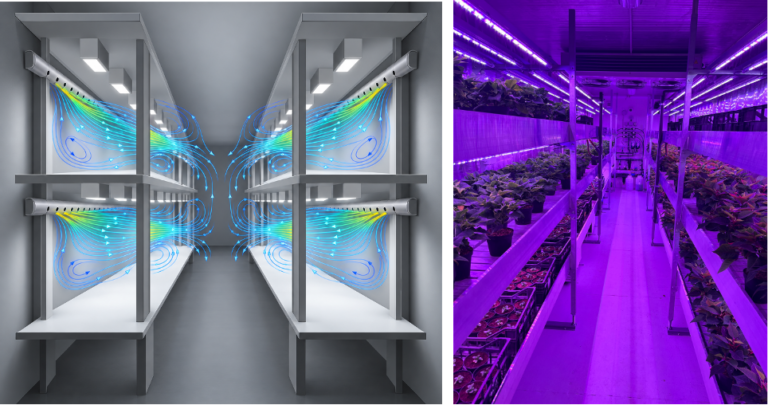
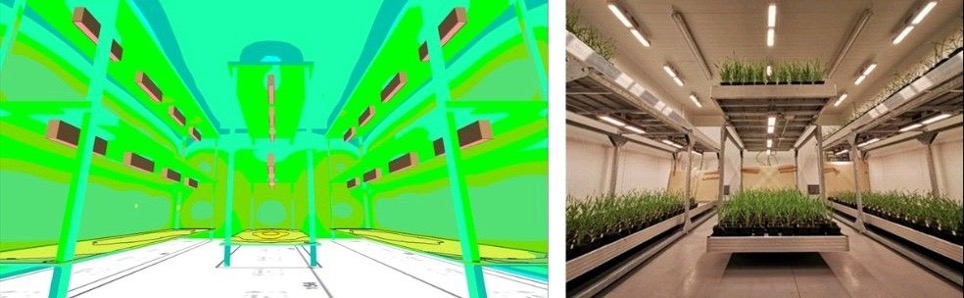
Figure 1. LED lighting simulation and real indoor growing facility.
A series of technical discussions initiated in recent days around potential improvements to LED systems brought us back to an apparently simple question: what does it really mean to design an effective lighting system for a vertical farm?
An interesting answer comes from the review published in 2025 by Lozano-Castellanos and colleagues, which analysed 70 scientific studies published between 2019 and 2024.
The first finding is predictable: LEDs are now the dominant technology in indoor farming due to their high photon efficacy, the possibility of controlling intensity and spectrum, and their integration with digital control systems.
But the most interesting point comes next.
Efficiency does not depend solely on the µmol/J value declared by the manufacturer. It also depends on how photons are distributed, how many actually reach the canopy and how effectively the plants can use them during the different stages of the growing cycle.
Light intensity, spectrum and photoperiod must therefore be connected to:
The review highlights the development of adaptive lighting systems in which sensors, the Internet of Things, biological models, machine learning and digital twins can modify light delivery according to actual environmental conditions and crop responses.
However, a second balance remains, and it is discussed far less frequently: the thermal balance.
The electrical power absorbed by LEDs is divided between emitted radiation and heat transferred directly through convection and conduction. Once photons are absorbed by leaves, growing trays and structural components, their energy also contributes to the thermal balance of the cultivation environment.
In multilayer systems, convective heat from the luminaires may warm the growing tier above, modifying root-zone temperature and the local microclimate. Radiation also affects leaf temperature, stomatal opening and transpiration, generating a latent load that must subsequently be managed through dehumidification.
Improving LED efficacy therefore means reducing the electrical energy required to produce a given photon flux. Designing the lighting system, however, also means understanding:
This is where GREATIT intends to focus its contribution.
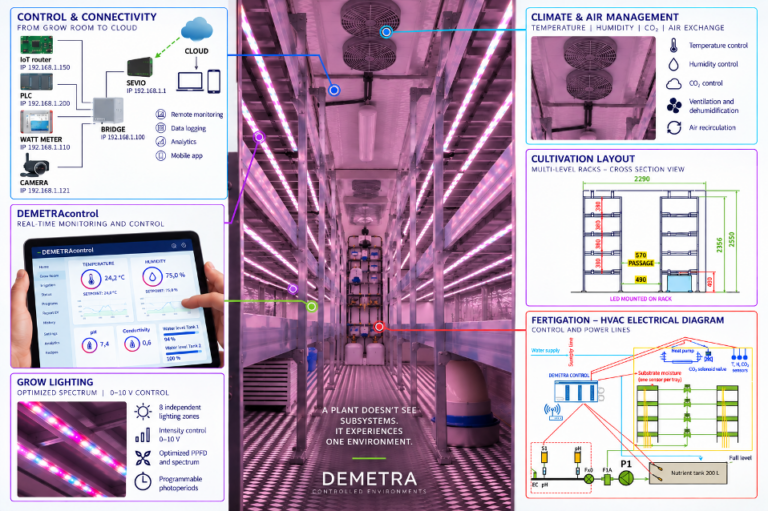
Through expertise developed over almost twenty years, continuous collaboration with universities, public and private research centres and technology partners, and the development of experimental systems such as DEMETRA, we work to translate scientific literature into measurable design criteria.
The objective is not simply to select a luminaire. It is to integrate lighting, crops, growing racks, HVAC, fertigation, sensors, control systems and energy recovery within the same biological and engineering balance.
With this article, we also want to open the discussion.
Which parameters should always be requested and measured before selecting an LED system for indoor farming? Are PPF, spectrum and photon efficacy sufficient, or should we also require thermal data, canopy-level light maps and performance measurements under actual operating conditions?
We invite researchers, designers, LED manufacturers, growers, technology providers and other industry professionals to share their experience, data and perspectives.
Because innovation moves faster when knowledge is openly discussed, challenged, tested and shared.
References
Lozano-Castellanos L.F. et al. (2025), Technologies Applied to Artificial Lighting in Indoor Agriculture: A Review, Sustainability, 17, 3196.
Open-access review
Neo D.C.J. et al. (2022), Shaping and Tuning Lighting Conditions in Controlled Environment Agriculture: A Review, ACS Agricultural Science & Technology, 2, 3–16.
DOI: 10.1021/acsagscitech.1c00241
Engler N., Krarti M. (2021), Review of Energy Efficiency in Controlled Environment Agriculture, Renewable and Sustainable Energy Reviews, 141, 110786.
DOI: 10.1016/j.rser.2021.110786
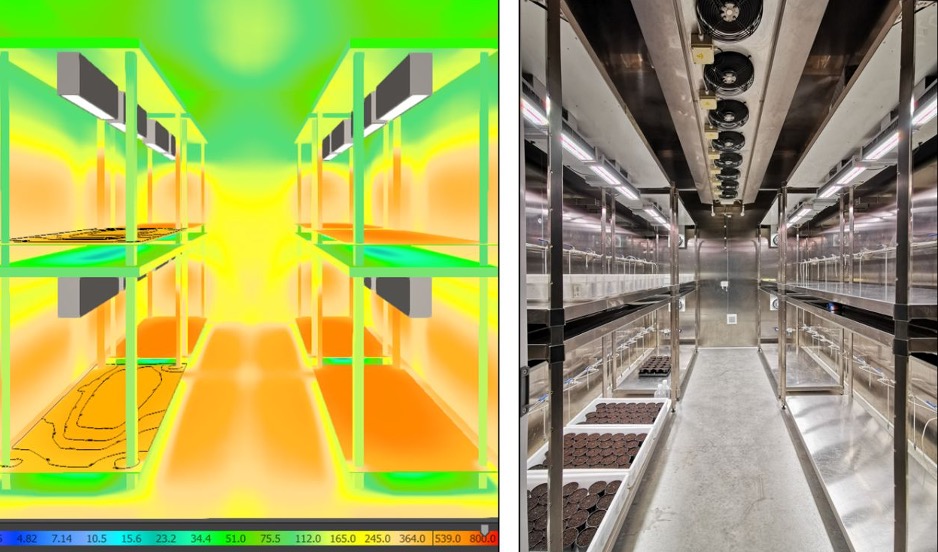
Figure 2. LED lighting simulation and real indoor growing facility.