Transpiration connects a plant’s water balance with the climate of its growing environment. Water vapour reaches the atmosphere through a pathway regulated by stomatal opening and air conditions near the leaf surface. Understanding the gradient driving this flux and the resistances controlling its magnitude provides a physiological basis for integrating humidity, airflow, lighting and water supply into cultivation system design.
The pathway of water through the leaf
Water reaching the leaf through the xylem supplies its tissues and evaporates from moist internal surfaces. Water vapour diffuses through the intercellular air spaces, reaches the substomatal cavity and passes through the stomatal pore. It then crosses the air layer adjacent to the leaf surface before reaching the surrounding atmosphere.
This pathway connects processes operating at very different scales: the opening of a microscopic pore, air movement between leaves and humidity management throughout the growing environment.
The flux can be described through two components: a difference in water vapour concentration that drives diffusion, and a series of resistances that regulate its magnitude.
The vapour gradient provides the driving force
In a simplified physiological model, the air inside the leaf is considered close to saturation at leaf temperature. The difference between internal vapour pressure and that of the surrounding air provides the gradient driving transpiration.
Leaf temperature therefore plays a decisive role: it determines the saturation vapour pressure used to estimate the leaf-to-air vapour pressure deficit.
At a given ambient vapour pressure, a change in leaf temperature alters evaporative demand. Vapour accumulation near the leaf surface can also reduce the local gradient available for diffusion.
Research has also shown that humidity gradients can develop within the leaf’s intercellular air spaces under certain conditions. The saturation assumption is therefore a useful simplification whose validity depends on physiological conditions. Wong et al., 2022, Humidity gradients in the air spaces of leaves
Two resistances along the pathway

Figura 1: vapour gradient drives diffusion through resistances in series
The first is stomatal resistance, associated with the opening and physical characteristics of stomatal pores. Guard cells regulate pore aperture in response to environmental conditions and the plant’s physiological state.
The second is boundary-layer resistance, associated with vapour transfer through the air close to the leaf. Leaf size, shape, orientation and local air movement all contribute to this resistance.
In a simplified model of the stomatal pathway, these resistances act in series. For a given gradient, greater total resistance reduces the flux, while lower resistance facilitates exchange. Studies connecting individual stomata with the surrounding boundary layer demonstrate how closely these transport processes interact. Defraeye et al., 2014
How air movement influences transpiration
Air movement facilitates vapour transfer from the leaf surface to the surrounding environment and generally reduces boundary-layer resistance.
Its effect depends on the airflow actually reaching the leaf. In a dense crop, overlapping leaves and canopy architecture can create zones with different exchange conditions. Air distribution therefore has a specific physiological role.
The outcome also depends on the relative contribution of each resistance. When stomatal resistance is high, reducing external resistance has a smaller effect on the overall flux. Airflow must therefore be interpreted alongside the plant’s physiological state.
Plants regulate their own water loss
An increase in the vapour gradient tends to promote transpiration at a given conductance. At the same time, the plant responds to the greater evaporative demand.
When water loss places pressure on the leaf’s water supply, stomatal regulation can reduce pore opening. Resistance increases, restricting the flux. This response also affects CO₂ entry and can limit photosynthesis.
Experiments in tomato have linked high vapour pressure deficit with water stress, abscisic-acid-mediated regulation and limitations to carbon assimilation. The final response therefore emerges from the interaction between atmospheric demand and the plant’s capacity to sustain gas exchange. Experimental study in tomato, 2021
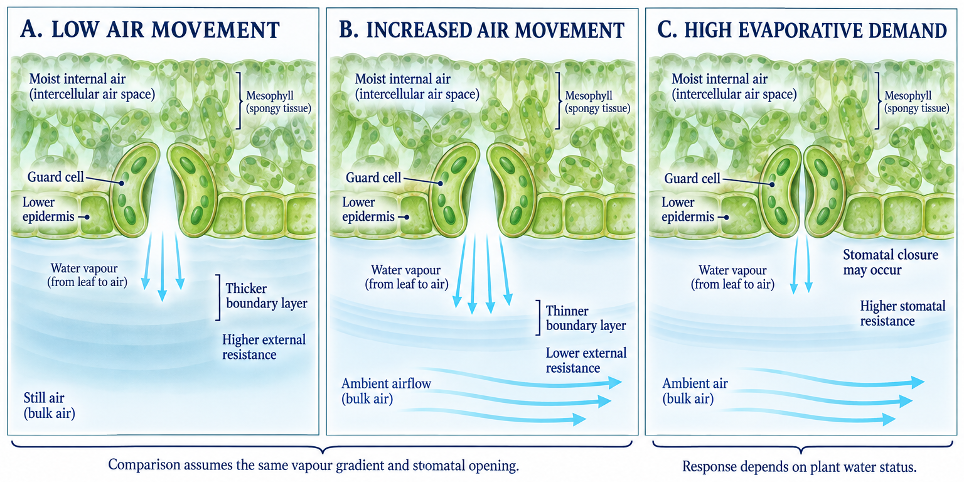
Figura 2: airflow modifies boundary-layer resistance. Plants regulate stomatal resistance.
From physiology to system design
In a cultivation facility, these mechanisms translate into practical decisions: distributing air within the canopy, managing humidity, interpreting leaf temperature and coordinating irrigation with crop demand.
The design task is to establish conditions that support the gas exchange and water balance required to achieve the production objective. Validation brings together plant responses, crop uniformity and resource use.
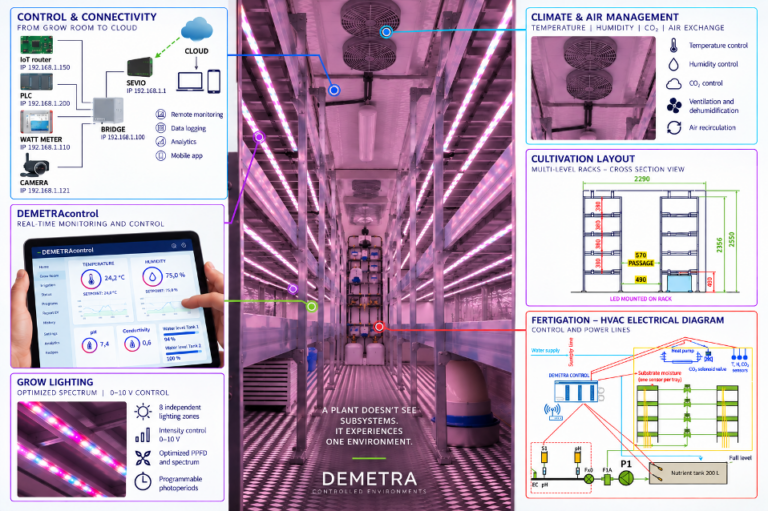
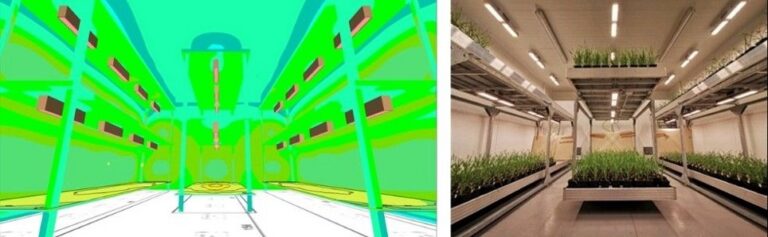
This connection between physiology and engineering underpins Great IT’s approach. Experiments on the DEMETRA platform allow environmental conditions to be assessed alongside crop responses, providing evidence to guide subsequent design decisions.
Figura 3: conceptual airflow simulation and GreatIT project on the right
Which factor limits gas exchange in different parts of the canopy: the vapour gradient, stomatal opening or air movement near the leaves?
Answering this question helps identify where to intervene and which response to measure in the crop.
#PlantPhysiology #Transpiration #ControlledEnvironmentAgriculture #ClimateControl #VerticalFarming #GreatIT #DEMETRA