By GREATIT – Scientific Department
A crop can thrive indoors while the business around it struggles. The case for a new facility begins with evidence about the product, its energy needs and the market it must reach.
Controlled-environment agriculture (CEA) has often been described through its equipment: LEDs, sensors, climate control and automation. Yet the decisive question is commercial. Can a facility supply a consistent product at a delivered cost that customers will support, with enough margin to sustain the operation?
The industry’s restructuring has made that question harder to avoid. AeroFarms entered Chapter 11 proceedings in 2023; Plenty announced its emergence from Chapter 11 in May 2025, with a renewed focus on strawberries. [1, 2] These cases do not establish a single cause of failure. They do underline the danger of treating technical achievement as proof of a viable business.
The crop sets the design brief
A project should begin with a defined product and a credible buyer. Expected yield, crop cycle, quality specifications and achievable selling price establish the requirements that engineering must meet. A basil crop, a strawberry crop and propagation material cannot be evaluated through the same production assumptions simply because all can be grown indoors.
Crop-first and business-first belong together. Agronomy determines what the plant needs; the business case determines whether meeting those needs creates value. Choosing between a high-tech greenhouse and a fully enclosed vertical farm should follow that assessment, rather than precede it.
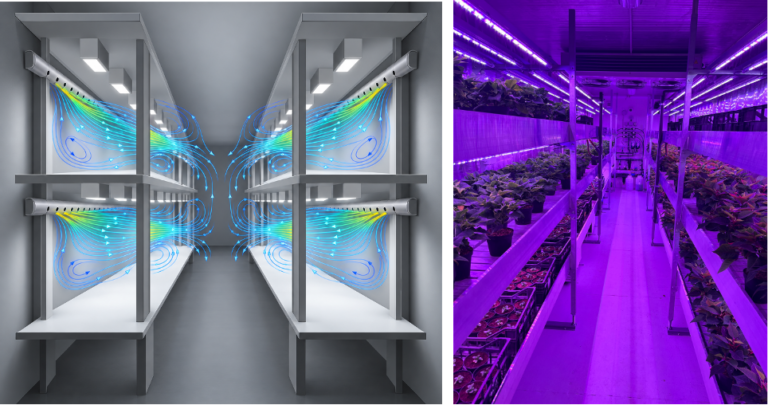
Light, temperature and humidity connect the two disciplines. More light can support growth, but it also draws electricity and changes the thermal load. Humidity control affects plant performance and the work required of climate systems. Research in Applied Energy modelled more than 180 combinations of growing conditions, examining how light intensity, temperature and vapour pressure deficit affect both yield and energy demand. [3] The design implication is clear: crop performance and building services must be evaluated together.
Energy belongs in the commercial model
Electricity cannot be treated as a final operating-cost allowance after the growing system has been selected. In a fully enclosed farm, artificial lighting and climate control are central to the production process. Their cost depends on the crop recipe, equipment efficiency, local climate and electricity tariff. A greenhouse has a different balance because sunlight contributes to production, while heating, cooling and supplementary lighting vary with location and season.
The relevant measure is therefore more than annual consumption. Energy per saleable kilogram links facility demand to the volume that can actually earn revenue. A higher-yield recipe may improve that measure, but only if its additional output meets quality standards and finds a buyer. The business plan should test lower realised prices, higher tariffs, slower crop cycles and weaker utilisation before the investment case is accepted.
Efficiency and environmental performance also require separate evidence. Lower energy use can improve costs, while the associated emissions depend on the electricity supply. Renewable procurement may strengthen a project, but it does not remove the need to control demand or account for the cost of reliable operation.
The economics continue beyond harvest
A crop leaving the growing room is still some distance from a completed sale. Grading, packing, cooling, storage and delivery consume resources and can reduce the volume ultimately sold. Shelf life affects how far the product can travel, how frequently it must be delivered and how much stock a customer can carry.
Proximity to customers can help, but short transport distances alone do not establish an advantage. Small shipments, frequent deliveries or an underused cold chain can erode the benefit. A study in the European Review of Agricultural Economics assessed leaf-lettuce supply chains serving New York City and demonstrated the importance of comparing production and distribution within the same economic and environmental boundary. [4] Its conclusions concern specific systems and assumptions, rather than every crop or location.
For project developers, this means validating the route to market alongside the crop. Buyer specifications, realistic volumes and delivery conditions should shape pilot trials early enough for the results to influence the facility design.
The pilot is where the investment case is tested
A useful pilot does more than demonstrate that a plant will grow. It tests whether the proposed operating model can produce a repeatable, saleable output. Yield and cycle length need to be assessed alongside energy use, labour, rejects, quality and shelf life, under conditions that resemble the intended commercial process.
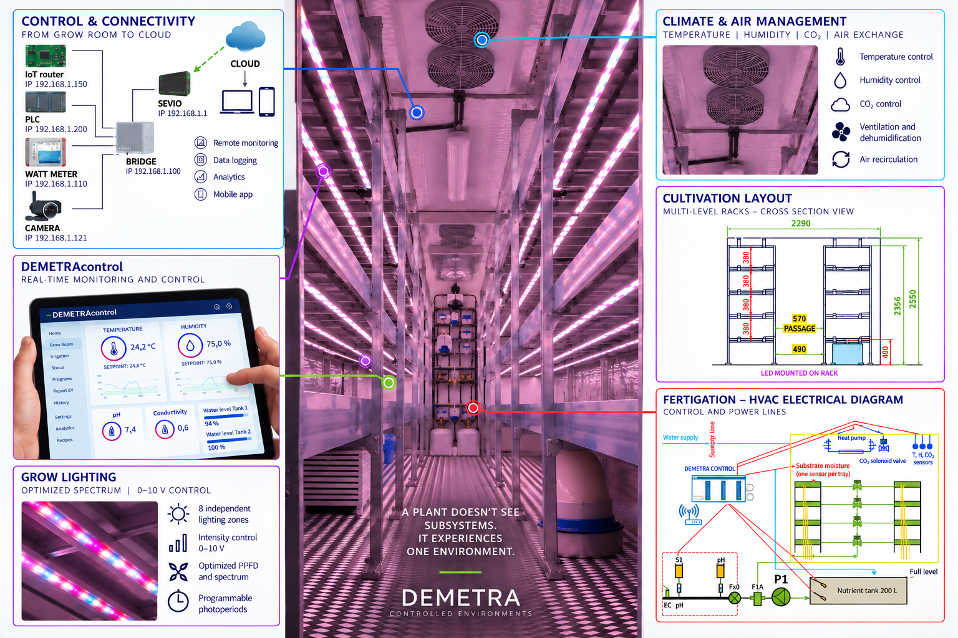
The quality of the evidence matters as much as the number of measurements. Repeated crop cycles help distinguish stable performance from an unusually good harvest. Energy and labour should be recorded within clearly defined boundaries; marketable yield should be separated from total biomass. Post-harvest trials and customer feedback can reveal problems that growing-room measurements miss. GREATIT’s DEMETRAcontrol control and data-acquisition system supports this work by recording operating conditions and helping define cultivation recipes that can be implemented through the facility’s control systems.
Figure 1. GREATIT’s control and data-acquisition architecture, illustrated here, supports cultivation recipe development and the implementation of control systems. Illustration supplied by GREATIT.
Pilot results are inputs to an industrial design, not a guarantee that scale will reproduce them. Air distribution, heat loads, staffing, maintenance and material handling change as a facility grows. The next decision should therefore combine measured crop performance with engineering analysis, capital requirements and a conservative commercial model. It may justify expansion, a different design or a decision to stop before more capital is committed.
A shared scientific framework for the Italian supply chain
GREATIT’s pilot-to-business approach begins with a discussion of what the client needs to achieve. A research centre may require flexibility for experimental work; an entrepreneur or farmer may need a system organised around a specific product and production process; a public-sector organisation may bring a different set of project objectives. GREATIT draws on experience across these sectors to translate those needs into a brief that connects biological requirements with structural and engineering decisions.
That brief is developed with the client and GREATIT’s network of specialist Italian suppliers. GREATIT leads the project as a single point of responsibility for the client, integrating crop requirements with lighting, climate control, fertigation, automation and the facility’s structure. Specialist suppliers contribute their manufacturing and engineering expertise within a design that GREATIT coordinates and is accountable for. The final design emerges from this shared process, informed by pilot evidence where crop performance or operating assumptions still need validation.
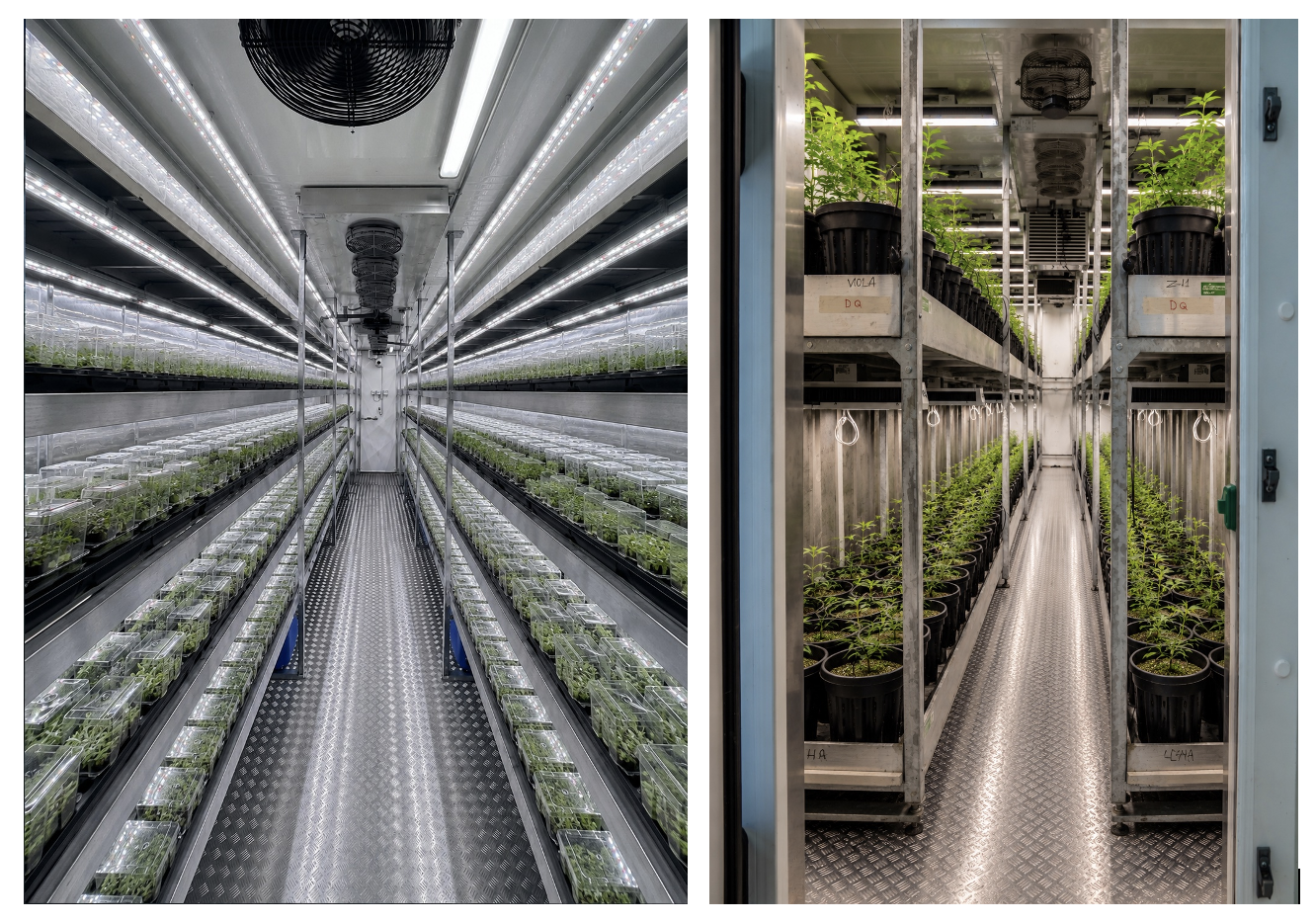
Figures 2 and 3. Left: a GREATIT micropropagation facility. Right: one of the medicinal-plant cultivation facilities delivered by GREATIT over the past two years. Photographs supplied by GREATIT.
This working method gives collaboration within the Italian supply chain a concrete purpose. A change in planting density or light strategy calls for a review of climate demand, handling requirements and cost. Decisions are considered across the project before specifications are finalised. The micropropagation and medicinal-plant facilities shown here illustrate the range of applications for which biological needs and engineering choices must be brought together.
For Italy, the opportunity is to bring this combined know-how to international CEA projects through results that can be examined and reproduced. Credibility will depend on demonstrated crop performance, disciplined engineering and an honest account of commercial limits. The farm should be built around that evidence. The pilot is where it begins.
To discuss a CEA project or a programme for moving from pilot validation to commercial production, contact GREATIT’s Scientific Department before the final design is set.
Sources and image credits
[1] AeroFarms. Business update on restructuring efforts, 13 July 2023. https://www.globenewswire.com/news-release/2023/07/13/2704214/0/en/AeroFarms-Provides-Business-Update-on-Restructuring-Efforts.html
[2] Plenty. Plenty completes restructuring, emerges from chapter 11, 29 May 2025. https://www.plenty.ag/plenty-completes-restructuring-emerges-from-chapter-11/
[3] Analysing the influence of growing conditions on both energy load and crop yield of a controlled environment agriculture space. Applied Energy, 2024. https://www.sciencedirect.com/science/article/pii/S030626192400789X
[4] Economic and environmental performance of controlled-environment supply chains for leaf lettuce. European Review of Agricultural Economics 50(4), 1547–1582, 2023. https://academic.oup.com/erae/article/50/4/1547/7207384
Images supplied by GREATIT. Figure 1 illustrates its control and data-acquisition system; Figures 2 and 3 show a micropropagation facility and a medicinal-plant cultivation facility, respectively.