Abstract
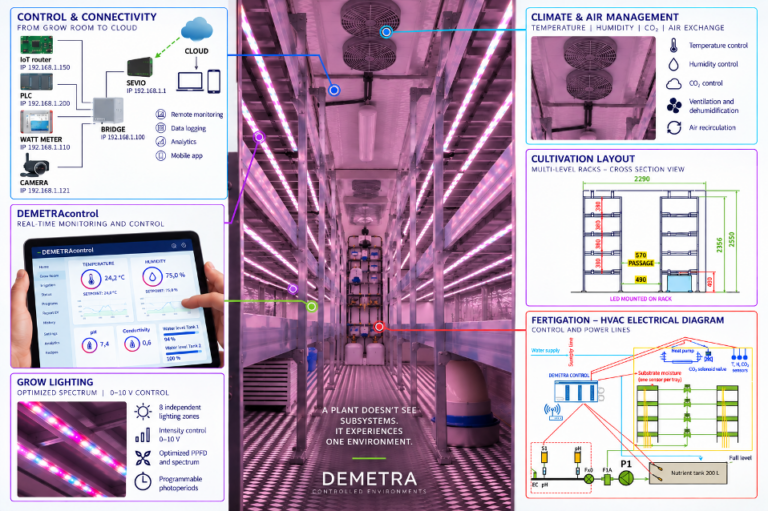
This integrated approach is at the core of Great IT’s work. Our team of plant scientists, agronomists and engineers supports customers in translating production objectives into coherent controlled-environment systems, integrating crop requirements, environmental control, automation and industrial operations from the earliest design stages. Through the DEMETRA platform, this approach can begin at pilot scale, allowing crops, protocols, yields, resource consumption and operating procedures to be validated before progressing towards a larger greenhouse or vertical farming facility.
Picture 1: Controlled environment agriculture facility showing the transition from technical design to an operational indoor cultivation system with multilayer growing racks, LED lighting and controlled-environment crops.
A plant does not see technical departments: it experiences one environment
In a controlled environment agriculture project, responsibilities are usually divided among specialists.
Plant scientists select crops and cultivation protocols. Lighting engineers design the illumination system. HVAC specialists calculate thermal loads and air treatment requirements. Agronomists define irrigation and nutrient management. Automation engineers develop control logic, while logistics specialists organise plant movement, harvesting and processing.
This division is necessary for managing complex projects.
The plant, however, does not experience these elements separately. It responds simultaneously to radiation, temperature, humidity, carbon dioxide, water availability, mineral nutrition, airflow and root-zone conditions.
For this reason, dividing a project into technical disciplines must not lead to designing those disciplines independently.
1. Genetics defines the biological potential
Every controlled cultivation system begins with a genotype.
Cultivars differ in morphology, growth rate, nutritional requirements, sensitivity to environmental stresses, resistance to pathogens, product quality and suitability for automated handling.
A compact cultivar may allow higher planting density. A fast-growing genotype may shorten the production cycle but create more demanding climate and fertigation requirements. A cultivar selected for open-field production may not necessarily express its full potential under artificial lighting or high-density indoor cultivation.
Genetics should therefore be selected together with the production environment and the intended industrial process—not after the facility has already been designed.
Research is increasingly emphasising the need to integrate plant biology, cultivar selection, environmental control and technological development in indoor agriculture. Frontiers in Plant Science
2. Light is both a biological input and an energy load
Light influences photosynthesis, morphology, development, pigmentation and product quality.
However, a lighting strategy cannot be defined only by selecting a target PPFD or light spectrum. Photoperiod, daily light integral, canopy architecture, fixture distribution, crop stage and photon-use efficiency must all be considered.
Lighting also interacts directly with the engineering system.
Electrical power supplied to the fixtures eventually becomes heat that must be managed. Changes in light intensity affect leaf temperature, photosynthetic activity, transpiration, water demand and humidity generation. Consequently, increasing the light supplied to the crop may require adjustments to cooling capacity, dehumidification, air movement and irrigation frequency.
The real design variable is therefore not simply “more light,” but the amount and timing of radiation that the plant can use efficiently within the overall energy and climate balance.
3. Climate control must follow plant physiology
Air temperature alone is not sufficient to describe the crop environment.
Relative humidity, vapour pressure deficit, leaf temperature, air velocity, carbon dioxide concentration and boundary-layer conditions collectively influence stomatal conductance, transpiration, nutrient transport and photosynthesis.
A climate-control system must therefore manage both sensible and latent loads while maintaining uniform conditions across the growing area.
This is particularly important in dense canopies and multilayer cultivation, where local microclimates can differ considerably from the measurements collected by a small number of room sensors.
Dynamic environmental control can potentially improve crop performance, energy efficiency and product quality, but it requires monitoring and control strategies based on plant responses rather than fixed environmental setpoints alone.Frontiers in Science
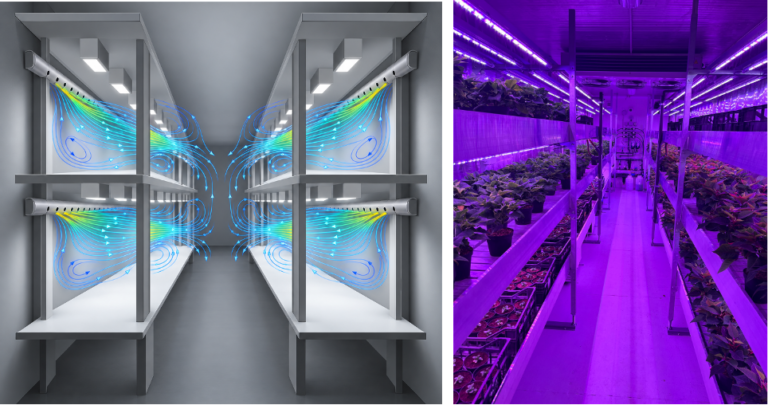
Picture 2: From pilot to scale: Controlled environment for precision grafting. A dedicated clean room designed for the grafting of young cucurbit and solanaceous plants, where multilayer cultivation combines uniform lighting, precise climate control and optimized environmental conditions. Temperature, humidity, airflow and light are managed to provide consistent conditions across every growing level, supporting graft healing, plant uniformity and reliable production performance.
4. Water management is connected to light, climate and operations
Water demand is not a fixed crop parameter.
It changes according to plant size, radiation, temperature, humidity, airflow, substrate characteristics and production stage. Irrigation must therefore respond to the conditions experienced by the crop rather than follow an isolated timetable.
The water system also affects the entire facility through storage, filtration, disinfection, oxygenation, recirculation and drainage management.
Its design determines not only water-use efficiency but also hydraulic reliability, biosecurity, nutrient stability and operational continuity. A technically efficient recirculation strategy that increases phytosanitary risk or requires excessive maintenance cannot be considered an optimised solution.
5. Nutrition is a dynamic biological process
Electrical conductivity and pH are useful control variables, but they do not provide a complete representation of plant nutrition.
Plants selectively absorb ions at rates that change during the production cycle. Water uptake and nutrient uptake do not always occur in the same proportions. Temperature, transpiration, oxygen availability and root-zone microbiology can further modify nutrient absorption.
Nutrient management must consequently be connected to water quality, irrigation strategy, crop stage, environmental conditions and the characteristics of the recirculation system.
A stable EC value does not necessarily mean that the nutrient solution remains physiologically balanced.
6. Automation should connect data with biological decisions
Sensors, control systems, machine vision and artificial intelligence can generate and process large quantities of data. Their value, however, depends on whether those data lead to meaningful operational decisions.
Automation should not merely control individual machines. It should connect environmental measurements, crop responses, resource consumption and production targets.
This requires appropriate sensor positioning, reliable data architecture, validated control logic and clear intervention procedures when measurements fall outside acceptable ranges.
Automation is most effective when it supports biological understanding. It cannot compensate for an incorrect cultivation model or for technical components that were never designed to operate together.
7. Logistics is part of the cultivation strategy
In an industrial CEA facility, plants must be seeded, germinated, transplanted, moved, inspected, harvested and processed.
These operations influence planting density, tray design, crop spacing, cycle duration, labour requirements and biosecurity. They must therefore be considered from the beginning of the agronomic design.
A cultivation protocol that performs extremely well at experimental scale may become impractical when it requires excessive handling, creates bottlenecks or cannot tolerate the timing constraints of an automated production line.
Scaling up is not simply a matter of increasing the number of plants. It means designing a repeatable flow of plants, materials, information and operations.
Integration is the real design challenge
The seven components cannot be optimised independently.
A genetic choice changes canopy architecture. Canopy architecture changes light distribution. Light affects photosynthesis, heat generation and transpiration. Transpiration modifies irrigation demand and latent HVAC loads. Water uptake alters nutrient concentration. Crop growth determines handling requirements, production timing and logistics.
Every decision propagates through the system.
The objective is not to maximise the performance of every subsystem. It is to identify the combination that delivers the required yield, quality, reliability and resource efficiency at an economically sustainable cost.
This is why controlled environment agriculture requires more than a collection of advanced technologies. It requires a common design language between plant science, engineering, automation and industrial operations.
A successful facility is not one in which every technical department has independently achieved its target. It is one in which the entire system works coherently around the plant.

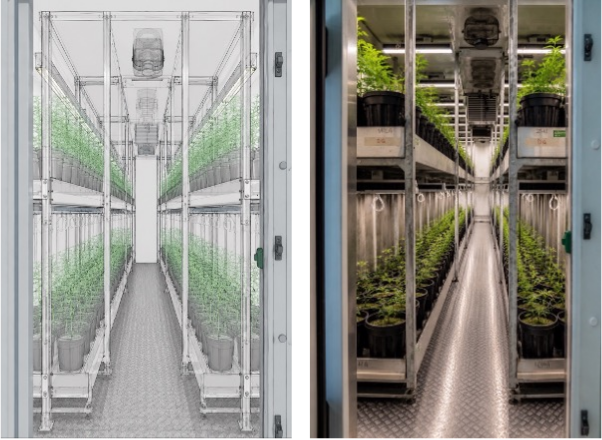
Picture 3. From pilot to scale: following he testing and validation phase carried out in the DEMETRA phytotron, Great IT supported the scale-up to the final greenhouse, applying the same principles of fertigation and climate management. Growing benches, fertigation strategies and cultivation performance were tested and validated with the client before being transferred to the full-scale facility.
Bibliography